A stalking trip in the Irish Highlands
Matthias is a hunter through and through. He comes from a family with a long hunting tradition and has been deeply immersed in the world of hunting since childhood. He grew up in the Rhineland hunting grounds of the Cologne Bay, which boast a healthy population of small game. Anyone familiar with this small-game hunting ground knows that it requires intensive and professional game management. Hares, partridges and pheasants have a wide variety of habitat requirements. It is the small game hunter’s task to manage these habitats.

And what would a passionate hunter be without a dog? Having always grown up with hunting dogs, it went without saying that Matthias would train his own dogs. So it wasn’t long before German hunting terriers and German Wirehaired Pointers made their appearance.
Another passion of his is hunting in other European countries. It is not only hunting in unfamiliar areas and for different game species that constantly captures Matthias’s interest. Striking up conversations with local hunters and getting to know their hunting methods is a great enrichment.

Hunting in the Irish Highlands
And so he found himself in Ireland.
The Emerald Isle has always drawn me in with its beautiful landscapes. As well as the well-known green meadows dotted with cows, it has one thing in particular to offer – the Highlands.
Barren heathland and moorland as far as the eye can see. Long ago, these Highlands were vast forests that were cleared as far back as the Middle Ages. Since then, they have been of economic use solely for peat extraction. For around 50 years, parts of the Highlands have been reforested with conifers, resulting in the development of substantial stands of mature forest to this day.
The fallow deer benefit particularly from the cover this provides, resulting in a healthy population.
The fallow deer here are largely active at night. However, it is by no means an easy hunt. They are very secretive and have exceptionally keen eyesight. Simply finding them in the quarries, moors and Highlands is a challenge in itself.
Whether the hunter can approach unseen to within shooting range is another matter entirely.

Demanding Stalking Under Extreme Conditions
In the highlands, with their sparse cover and perpetually wet conditions, getting about is extremely difficult. The ground is very uneven and one quickly sinks up to one’s hips in waterlogged holes. A clever hunter makes use of the fallow deer’s centuries-old trails to get about. To get within shooting range of game, the hunter often has no choice but to approach by crawling.
What I am trying to describe here is that the hunter must possess specific qualities.
He must be in excellent physical condition and sure-footed, as considerable distances are covered whilst stalking. Once an animal has been shot, he must be able to retrieve it unaided.
Stalking must be carried out in accordance with all the rules of the hunting craft, which means taking the wind direction into strict account and making the most of the terrain.
Clothing must be windproof and waterproof. This can only be achieved with high-quality and well-coordinated clothing.

The right choice of rifle and ammunition
Particular attention must be paid to marksmanship, the rifle and the ammunition. Often, one cannot get closer than around 200 metres to the fallow deer. As hunting here is carried out exclusively by stalking, one must be able to shoot accurately at this distance whilst lying down or from a shooting stick.
As we rarely shoot at long ranges in Germany, very few of our hunters own classic long-range calibres. However, this is not a problem when it comes to choosing the right cartridge.
I shoot the 8x57 IS calibre. It is certainly not known as a long-range calibre. However, when paired with a light bullet, it can be relied upon to perform well even at long distances.
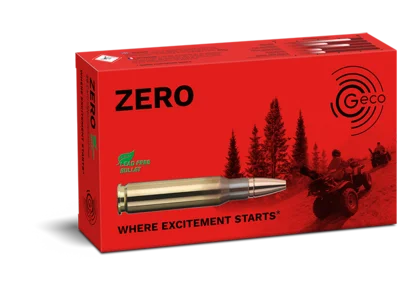
For this purpose, I choose the lead-free GECO ZERO. The light bullet has a flat trajectory.
In the extremely challenging terrain of the Highlands, even finishing off wounded game becomes a challenge. Here, too, the GECO ZERO is the right choice.
The excellent instantaneous effect, the high probability of a clean kill thanks to the residual bolt, and the reliable production of tracking signs all underpin my choice of the GECO ZERO.

Conclusion
Rarely do so many factors have to align as they do in the rugged Irish Highlands to ensure a successful hunt. Conditions such as wind, weather and the behaviour of the game cannot be influenced. The setup is one factor that the hunter himself can control.
Now all that’s needed is a little bit of luck – good hunting.
Text: Marlon Santoro
Images: Martina Rohn
Centrefire rifle cartridges
GECO ZERO
GECO ZERO is a highly effective and accurate, lead-free bullet for all types of game.
Calibers:

GECO ZERO